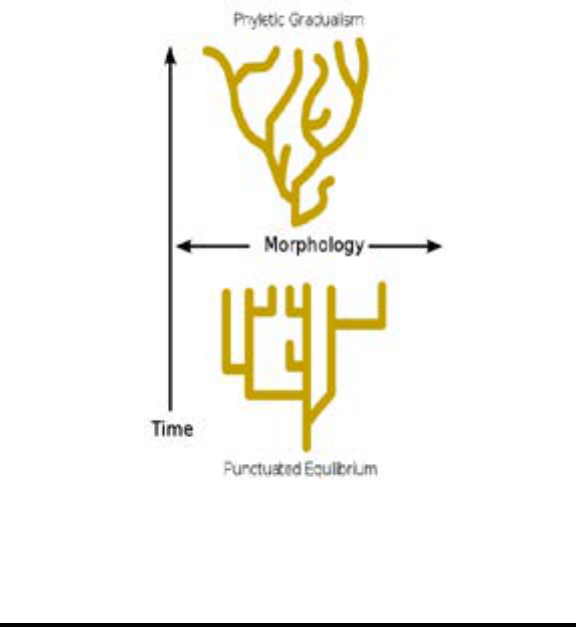
APPENDIX Z34: Punctuated equilibrium*

Published on 24 Jun 2016 at 1:42 pm. Comments Off on APPENDIX Z34: Punctuated equilibrium*.
Filed under Uncategorized.

APPENDIX Z34:
Punctuated equilibrium*
from Wikipedia
Punctuated equilibrium (also called punctuated
equilibria) is a theory in evolutionary biology which
proposes that most species will exhibit little net
evolutionary change for most of their geological
history,
remaining in an extended state called stasis. When
signicant evolutionary change occurs, the theory
proposes that it is generally restricted to rare and
geologically rapid events….”

145 APPENDIX
Punctuated equilibrium, consists of morphological
stability and rare
bursts of evolutionary change
from the author –
Clearly, Punctuated
Equilibrium works far better with
Q4P
in the equation, i.e. with Q4P
driving and igniting
the leaps-forward. What other hypothesized dynamic
is
punctuating the equilibrium?
Indeed, when now lining-up all the areas – even just
those
alone which have been articulated in Summa – where

Q4P
provides a signicantly more elegant conceptual
framework than any sans-Q4P
hypotheses, it would
seem that a somewhat compelling case has been
made.
Especially since there is no known competing,
compelling
alternative.
Respectfully, Summa de facto stands alone. It may turn
out to be wrong, but it would currently seem to be the
overwhelmingly and distinctively aesthetically
elegant
metaphysics.
Perhaps mainstream
academic scientic and philosophical
thought should endeavor to transcend its inertia.
Perhaps academia will now undergo its own
Punctuated
Equilibrium…and go with a winning new paradigm 😉
as its
working hypothesis, as opposed to its current
(somewhat
pathetics) modus operandi: of operating without any
real
conceptual context.
*Wikipedia Online, http://en.wikipedia.org/wiki/Punctuated_equilibrium (accessed June 4, 2012)

APPENDIX Z33: The Red Queen Hypothesis

Published on 24 Jun 2016 at 1:40 pm. Comments Off on APPENDIX Z33: The Red Queen Hypothesis.
Filed under Uncategorized.

APPENDIX Z33:
The Red Queen
Hypothesis
Classic application to evolution:
from Wikipedia*
a
“The Red Queen’s Hypothesis, also referred to as Red
Queen, Red Queen’s
race or Red Queen Eect, is an
evolutionary hypothesis. The term is taken from the
Red
Queen’s race in Lewis Carroll’s Through the Looking-Glass
and involves the Red Queen and Alice constantly
running,
yet remaining in the same place.
“Well, in our country,”
said Alice, still panting a little, “you’d
generally get to somewhere else — if you run very
fast for
a long time, as we’ve been doing.”
“A slow sort of country!” said the Queen. “Now, here, you
see, it takes all the running you can do, to keep in
the
same place. If you want to get somewhere else, you
must
run at least twice as fast as that!”

The Red Queen Principle can be stated thus:
In reference to an
evolutionary system, continuing
adaptation [and successive procreation] is needed in
order for a species to maintain its relative tness amongst
the systems being co-evolved with.*
b
….”
BIRNBAUMIAN application to the cosmic order:
Successive evolutionary and cosmic advance – on
myriad
levels – is necessary for the cosmos not to devolve
into
entropy.*
c
A parallel to this might be the dynamic of skimming
a rock
along the surface of a pond. The rock must be
projected
within a given angle tolerance and within a given
speed
and acceleration tolerance, in order not to fall
into the
water.
To “defy gravity,” the skimming rock must advance.
Likewise, the cosmic order: To defy entropy, it must
advance… playing-out cosmic potential and
advancing-
towards Extraordinariation.
*
a
Wikipedia online, http://en.wikipedia.org/wiki/Red_Queen’s_Hypothesis#cite_note-1
(accessed June 4, 2012)
*
b
http://pespmc1.vub.ac.be/REDQUEEN.html
*
c
Birnbaumian corollary to the Second Law of
Thermodynamics

APPENDIX Z32: Aesthetic Elegance

Published on 24 Jun 2016 at 1:37 pm. Comments Off on APPENDIX Z32: Aesthetic Elegance.
Filed under Uncategorized.

APPENDIX Z32:
Aesthetic Elegance
After multi-day discussion/debate at Bard
College,
Annandale-on-Hudson, Upstate,
NY as to the sine
qua non (~the necessary aspect) of a powerful
metaphysics, the consensus emerged that since
metaphysics (by its innite nature and ambition) does not
lend itself to formal scientic proof, its aesthetic elegance
indeed emerges as perhaps its key dening aspect.*
Of course, aesthetic elegance, seemingly subjective, in
reality embraces many clinical components. Presumably
the metaphysics under examination at-a-minimum passes
muster vis à vis the litmus test checklist proposed at the
very beginning of the appendix section in Appendix
A:
Metaphysics Analysis.

Now, the human psyche is
awesomely complex. But it
ultimately often seeks to boil-down a litmus test
checklist
to just one concept. Aesthetic elegance
presents itself as
a viable candidate in metaphysics.
*
Incorporated into
qualication for aesthetic elegance
would
necessarily be the
requirement that the metaphysics comports
with ‘actual knowledge’
i.e. the hard and soft
sciences

APPENDIX Z31: Simple v. Simplistic

Published on 24 Jun 2016 at 1:35 pm. Comments Off on APPENDIX Z31: Simple v. Simplistic.
Filed under Uncategorized.

APPENDIX Z31:
Simple v. Simplistic
Metaphysicians and scientists like their theories
simple
yet sophisticated. Thus, Einstein’s iconic Theory of
Relativity, E=MC
2
is simple, but highly sophisticated.
Many theories and laws of physics follow this
general
paradigm: Simple, yet sophisticated.
Now in our little realm of metaphysics, we posit
that
Q4P
is simple, yet sophisticated.
Q4P
enthusiasts would argue that (linear)
Aristotelianism
(i.e. Eternal God deployed primal matter and created
the
Earth) is simply simplistic*.
*or in any event, more in the realm of theology
139 APPENDIX
“Everything should be made
as simple as possible,
but no simpler”
Albert Einstein
(c. 1933)

APPENDIX Z30: Schopenhauer v. Birnbaum

Published on 24 Jun 2016 at 1:34 pm. Comments Off on APPENDIX Z30: Schopenhauer v. Birnbaum.
Filed under Uncategorized.

APPENDIX Z30:
Schopenhauer v. Birnbaum
from Wikipedia*
Arthur Schopenhauer (22 February 1788 21 September
1860) was a German
philosopher known for his pessimism
and philosophical clarity.
At age 25, he published his
doctoral dissertation, On the Fourfold Root of the
Principle of Sufcient Reason, which examined the four
separate manifestations of reason in the
phenomenal
world.
Schopenhauer’s most
inuential work, The World as Will
and Representation, claimed that the world is fundamentally
what humans recognize in themselves as their will.
His
analysis of will led him to the conclusion that
emotional,
physical, and sexual desires can never be fully
satised.
The corollary of this is an ultimately painful
human
condition. Consequently,
he considered that a lifestyle
of negating desires, similar to the ascetic
teachings of
Vedanta, Buddhism and the
Church Fathers of early
Christianity, was the only
way to attain liberation.

Schopenhauer’s
metaphysical analysis of will, his views
on human motivation and desire, and his aphoristic
writing style inuenced many well-known thinkers,
including Friedrich Nietzsche, Richard Wagner, Ludwig
Wittgenstein, Erwin
Schrödinger, Albert Einstein, Sigmund
Freud, Otto Rank, Carl Jung, Joseph Campbell, Leo
Tolstoy, Thomas Mann, and Jorge Luis Borges….”
from the author –
So Schopenhauer’s The World as Will and Representation
posits that the world is
fundamentally ‘will’; and ‘pessimist
school’ Schopenhauer comes to the conclusion that
negating ‘will’ is the ‘route to liberation.
Birnbaum’s Summa Metaphysica posits that the world
is essentially ‘potential’; and, to continue
counterposing
Schpenhauer,
‘optimist-school’ Birnbaum comes to the
(quick) conclusion that proactive ‘Quest for Potential’ is
the true ‘route to liberation.’
*Wikipedia Online, http://en.wikipedia.org/wiki/Arthur_Schopenhauer (accessed May 21, 2012)

APPENDIX Z29: Occam’s Razor

Published on 24 Jun 2016 at 1:32 pm. Comments Off on APPENDIX Z29: Occam’s Razor.
Filed under Uncategorized.

APPENDIX Z29:
Occam’s Razor
Occam’s razor (also written as Ockham’s razor, Latin
lex parsimoniae) is the law of parsimony, economy or
succinctness. It is a principle urging one to select
among
competing hypotheses that which makes the fewest
assumptions and thereby offers
the simplest explanation
of the effect.”*
Summa offers a so-to-speak ‘simple’, but
purportedly
sophisticated and powerful proposition:
Quest for Potential
ignited,
drives and indeed, is, the cosmos.
Occam might smile.
*Wikipedia Online, http://en.wikipedia.org/wiki/Occam’s_razor (accessed April 25, 2012)

APPENDIX Z28: Theory of Everything* (in Physics)

Published on 24 Jun 2016 at 1:31 pm. Comments Off on APPENDIX Z28: Theory of Everything* (in Physics).
Filed under Uncategorized.

APPENDIX Z28:
Theory of Everything* (in Physics)
“A theory of everything (TOE) or nal theory
is a
putative theory of theoretical physics that fully
explains
and links together all known physical phenomena,
and
predicts the outcome of any experiment that could be
carried out in principle.
Many candidate theories of everything (in physics)
have been proposed by theoretical physicists during
the twentieth century, but
none have been conrmed
experimentally. The
primary problem in producing a TOE is
that general relativity and quantum mechanics
are hard to
unify. This is one of the
unsolved problems in physics….
While loop quantum gravity [theory] attempts to
unify
quantum eld theory and general
relativity/gravitation,
string theory and its successor M-theory, remain the only
prominent candidates as a theory of everything.”
*Wikipedia Online, http://en.wikipedia.org/wiki/Theory_of_everything (accessed April 25, 2012)

from the author –
Summa, of course, fully embraces physics, and
believes
that Q4P
is by denition fully synchronous with physics.
Metaphysics is about painting a “bold brush
stroke”
super-macro overarching conceptual Theory of Everything
(meaning, a “real deal” Theory of Truly Everything). The
correct [overarching]
metaphysics theory would embrace
within its fold the correct [overarching] physics theory.
The author respectfully believes that ultimately
physics will
be compelled to make its way to Q4P
in order to cross
the nal theoretical bridge in its quest for a Theory of
Everything (in Physics), including Big Bang
Theory.
Note that as a reference
to their work, metaphysicians
avoid using that (TOE) terminology or a more precise
phrase for metaphysics like “Macro Theory of
Everything,”
because the terminology projects/resonates as being too
presumptuous. But conceptual macro brush strokes is
essentially what metaphysics is ultimately all
about. Macro
Everything. That is what metaphysicians are paid to
do.

APPENDIX Z27: Multiverse Theory

Published on 24 Jun 2016 at 1:27 pm. Comments Off on APPENDIX Z27: Multiverse Theory.
Filed under Uncategorized.

APPENDIX Z27:
Multiverse Theory
Multiverse is a theory in physics. It is not a
classic
metaphysics overarching the gamut of elds of
knowledge.
So, for instance, as regards
the classic question as to
where our universe came from,
if one proposes as an
answer that it is part of – or a “daughter of” – a
multiverse
cosmic order, one still
needs to address where the
“mother universe(s)” came from.

APPENDIX Z26: String Theory and ‘Provability’

Published on 24 Jun 2016 at 1:26 pm. Comments Off on APPENDIX Z26: String Theory and ‘Provability’.
Filed under Uncategorized.

APPENDIX Z26:
String Theory and ‘Provability’
String Theory is a contender for the “theory of
everything
in physics.”
After 40 years of intense effort (and
failure) by String Theory
advocates to make
predictions which can denitively
be tested by experiment,
String Theory is nevertheless
essentially accepted by
its many and often quite-eminent
scientic community proponents
because of it’s elegance,
its conceptual aesthetic
appeal, and its relative power vis à
vis other contending theories. As well, there is the hope of its
advocates that in the
future there may be some measurable
consequences. On net
balance to date, it is a noble
effort by
many hundreds of scientists to transcend mortal
and current
scientic limitations.
Thus, in Physics, which demands as an almost
inviolable
sine qua non (essential condition) testability, provability
and ultimately proof, in this instance an untested
and
unproven theory is nevertheless held in the
highest
possible (international) esteem.
Note that Metaphysics, which more often than not
probes the innite, the transcendent, and
universal
cosmic axioms, does not require scientic proof per se. It
inviolably requires,
however, the absence of contradiction
with physics and science, as a whole.

APPENDIX Z25: Where is the Divine?

Published on 24 Jun 2016 at 1:24 pm. Comments Off on APPENDIX Z25: Where is the Divine?.
Filed under Uncategorized.

APPENDIX Z25:
Where is the Divine?
Metaphysical challenge:
Choose from these multiple
choice options:
a) Nowhere
b) Up there / Separate
from us
c) Here
d) Here, and it encompasses
all / We are part of It
– and integral to It.
Summa rejects (a) and (b), agrees with (c) but embraces (d).
The author is dubious that any metaphysics, which
embraces (a) or (b) can present a viable
integrated,
holistic and fully-satisfying option. Summa believes
that
the metaphysical debate needs to take place within
the
embrace of (c) or (d).

Atheism embraces (a)
Note that Aristotelianism (Aristotle was the student
of
Plato, who in turn was the student of Socrates)
and
classic mainstream Western (religious) thought classically
both embrace (b).
Taoism and much Eastern
philosophical/religious thought
embrace (c) or (d).
“We are made of light, and we are all
part of God’s mind. Most
importantly, we are the universe itself having the experience of
knowing that.” (Fred
Alan Wolf, Time Loops and Space Twists,
p. 232)

Chapters